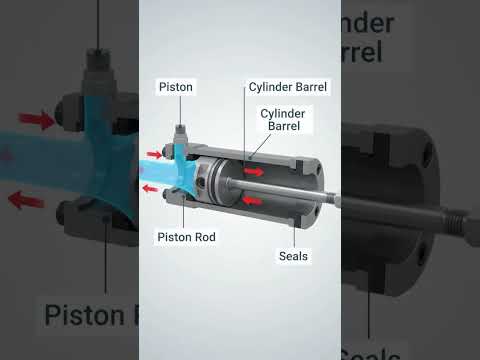
Have you ever wondered how CNC machines perform complex, highly repetitive movements with surgical precision? While digital code drives the intelligence behind these advanced systems, physical actuators like pneumatic cylinders do the heavy lifting under the hood. Understanding basic CNC theory starts with mastering how these vital mechanical components convert energy into precise, reliable linear motion.
What is a CNC Cylinder?
In modern automated machining, pneumatic and hydraulic cylinders act as the muscle of the machine tool. They are mechanical devices engineered to produce force in a straight line using pressurized fluid or, more commonly, compressed air.
Within a typical CNC setup, cylinders perform several critical tasks: * Workholding and Clamping: Securing raw materials firmly in place to prevent vibration during heavy cutting operations. * Automatic Tool Changers (ATC): Rapidly swapping out cutting tools between operational sequences. * Automated Guarding: Smoothly opening and closing machine safety doors.
How Pneumatic Cylinders Operate Under the Hood
To understand how pneumatic cylinders function within practical CNC theory, it helps to look at their core internal mechanics.
When compressed air enters one chamber of the sealed cylinder barrel, it builds pressure against an internal piston. This pneumatic force pushes the piston rod outward, extending the cylinder to perform work. To retract the rod, directional control valves redirect air to the opposite chamber while venting the original side.
These rapid extension and retraction cycles are controlled directly by the CNC system via solenoid valves. The seamless bridge between computerized code and mechanical air pressure is a foundational concept in fundamental CNC theory.
Key Advantages in Modern Manufacturing
Pneumatic cylinders remain the industry standard across machining centers for several key reasons: * High Speed: They react almost instantaneously to controller commands, significantly cutting down cycle times. * Low Maintenance: With simple designs and fewer moving parts than electric actuators, downtime is kept to a minimum. * Built-In Cushioning: Compressed air naturally absorbs mechanical shocks, protecting delicate tooling and workpieces from damage.
Final Thoughts
Grasping how individual components operate behind the scenes transforms complex manufacturing into actionable knowledge. Expanding your understanding of machine mechanics and CNC theory empowers operators, programmers, and engineers to troubleshoot issues faster, optimize machine performance, and achieve superior machining accuracy.


