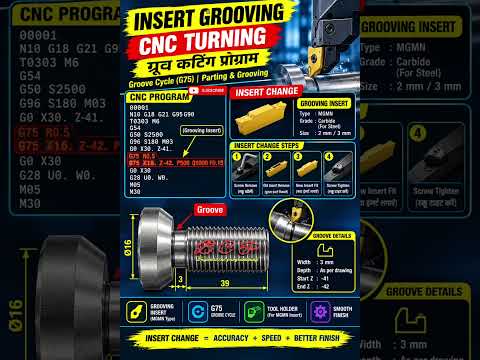
Precision machining relies heavily on efficient, standardized code. When performing turning operations on a lathe, creating deep or wide grooves line-by-line can be tedious and prone to manual programming errors. This is where mastering the Fanuc G75 canned cycle becomes essential for modern CNC programming.
What is the Fanuc G75 Grooving Cycle?
The G75 code represents the multi-grooving peck cycle on Fanuc CNC controls, used for both outer diameter (OD) and inner diameter (ID) grooving. Instead of executing continuous single-line cuts—which can lead to tool breakage and long, dangerous stringy chips—the G75 cycle automates peck grooving. It feeds the cutting insert into the material in precise increments, retracts slightly to break chips, and steps over along the Z-axis until the desired groove dimensions are achieved.
Understanding the G75 Block Structure
On Fanuc control systems, the G75 cycle is typically written in a convenient two-line block format:
Line 1: G75 R(e);
* R(e): The retraction distance after each peck cut to relieve chip pressure.
Line 2: G75 X(U) Z(W) P(Δi) Q(Δk) R(d) F(f);
* X(U): Target position or depth of the groove on the X-axis.
* Z(W): Target end position along the Z-axis (for wider grooves).
* P(Δi): Peck amount in the X-axis direction (expressed in microns).
* Q(Δk): Step-over distance along the Z-axis (expressed in microns).
* R(d): Relief amount at the bottom of the cut (if required).
* F(f): Feed rate for the operation.
Key Benefits of the G75 Cycle
Integrating automated cycles into your workflow drastically simplifies code writing and reduces overall program size. High-efficiency CNC programming requires balancing fast cycle times with tool longevity. By using the G75 peck grooving method, coolant penetrates the cut area better, heat build-up is controlled, and insert wear is minimized.
Conclusion
Whether you are machining narrow retainers or wide shoulder grooves, using the G75 grooving cycle is an indispensable skill. Practice implementing this cycle in your routines to enhance your CNC programming capability, improve chip control, and ensure high-precision parts on the shop floor.


