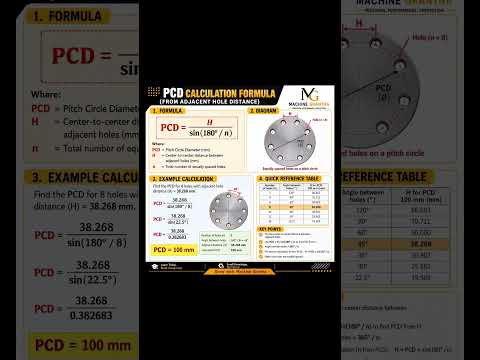
In the high-stakes world of modern manufacturing, precision isn’t just a goal—it’s a requirement. As shops around the globe transition toward advanced CNC automation, the ability to perform quick, accurate manual calculations remains a foundational skill for every elite operator. One of the most essential calculations you will encounter is the Pitch Circle Diameter (PCD).
What is PCD and Why is it Vital?
The Pitch Circle Diameter (PCD) is the diameter of an imaginary circle that passes through the exact centers of a circular pattern of holes, such as those found on a wheel hub, flange, or gear. Whether you are programming a Vertical Machining Center (VMC) or setting up a lathe, getting the PCD right is the difference between a perfect assembly and a wasted piece of stock.
While modern CNC automation software can often handle these coordinates, understanding the math behind the machine allows operators to troubleshoot errors, verify blueprints, and make on-the-fly adjustments without relying solely on a computer.
The PCD Calculation Formula
To calculate the PCD when you know the distance between two adjacent holes (the chord length) and the total number of holes, use the following trigonometric formula:
PCD = L / sin(180 / n)
- L: The linear distance (center-to-center) between two adjacent holes.
- n: The total number of holes in the circle.
- sin: The sine function from your scientific calculator.
For example, if you are measuring a 6-hole pattern and the distance between two holes is 50mm, your calculation would be:
PCD = 50 / sin(180 / 6) = 50 / sin(30) = 50 / 0.5 = 100mm.
Bridging the Gap Between Math and Automation
Integrating these manual tips into your daily workflow enhances the reliability of your CNC automation processes. When you feed precise, verified data into your CNC controllers, you reduce the risk of tool breakage and part rejection.
Precision at the programming stage ensures that the automated cycle runs smoothly from start to finish. By mastering the PCD formula, you position yourself as a more versatile technician capable of bridging the gap between traditional craftsmanship and the future of automated manufacturing. Keep these formulas handy, and you'll find that your efficiency on the shop floor will reach new heights.


