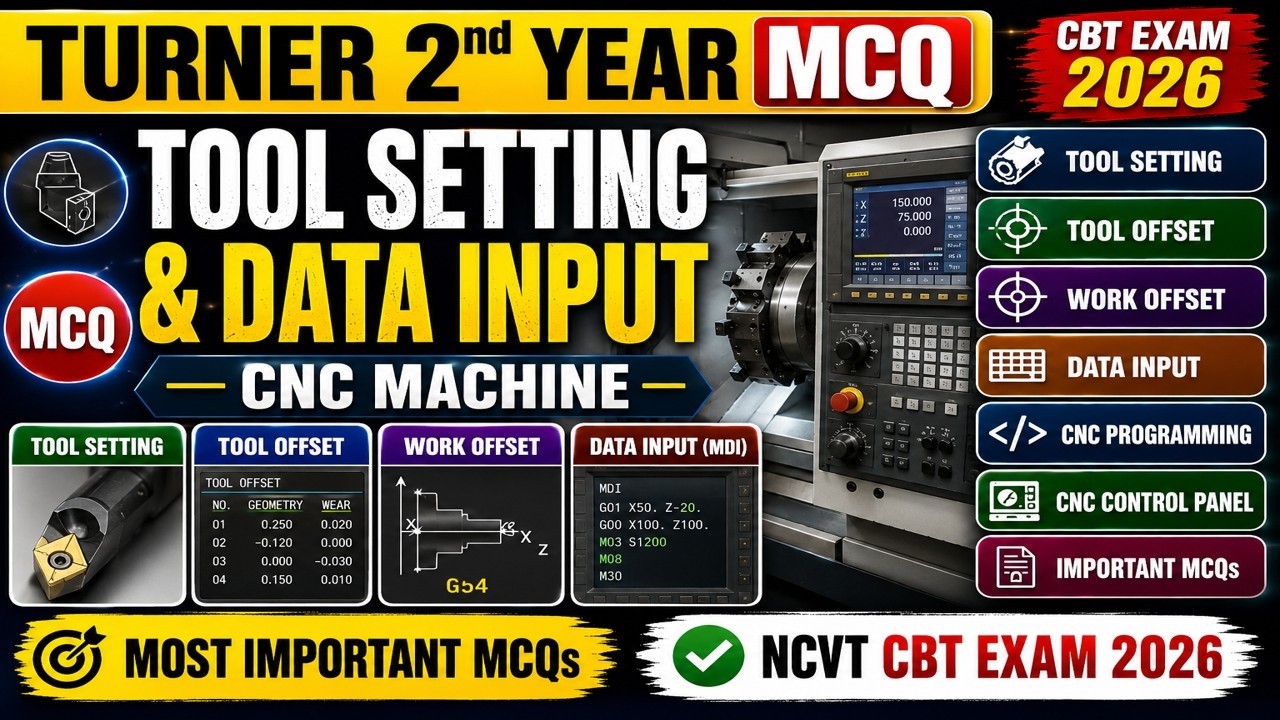
Master Tool Setting and CNC Data Input: Essential ITI Turner Theory Guide
This article provides an in-depth exploration of CNC data, covering foundational concepts, practical applications, and engineering insights.
Computer Numerical Control (CNC) machining has revolutionized modern manufacturing, turning manual lathe operations into high-precision, automated processes. For ITI Turner second-year students preparing for their Computer Based Test (CBT) exams, understanding the core theoretical principles behind machine operations is vital for academic and practical success. Among the most crucial topics in the curriculum are tool setting and the accurate input of CNC data.
Understanding Tool Setting and Data Input
In CNC turning operations, tool setting is the process of defining the exact physical position of cutting tools relative to the machine's reference point. Once the tool geometry and wear offsets are measured, operators must properly enter these values into the machine's control unit. Entering accurate CNC data—such as tool offset values, work coordinate offsets (G54-G59), and cutting parameters—ensures that the machine executes G-code commands with extreme precision.
If incorrect information is fed into the controller, it can lead to dimensional errors, poor surface finishes, or severe tool collisions. Therefore, mastering data input procedures is not just an exam requirement, but a fundamental safety skill on the modern workshop floor.
Key Exam Topics for ITI Turner Students
To excel in your second-year CBT theory exam, focus on the following key concepts related to CNC machine operation:
- Tool Offset Management: Learning how X-axis and Z-axis offsets are measured, calculated, and stored in the system memory.
- Controller Interface Navigation: Knowing how to access offset screens and correctly modify positional values.
- Coordinate Systems: Understanding the relationship between Machine Zero, Work Zero, and Tool Reference Points.
- Program Verification: Utilizing dry runs and single-block modes to verify operational commands before starting actual cutting.
By practicing multiple-choice questions (MCQs) focused on these areas, students gain a clearer understanding of how raw CNC data translates into physical machining movements.
Final Thoughts
Thorough preparation in CNC theory bridges the gap between theoretical knowledge and shop-floor practical execution. Focus on understanding the core logic behind tool offsets and parameter inputs, review relevant exam MCQs, and build the confidence needed to clear your CBT exam with top marks.
Visual Insights & Illustrations


