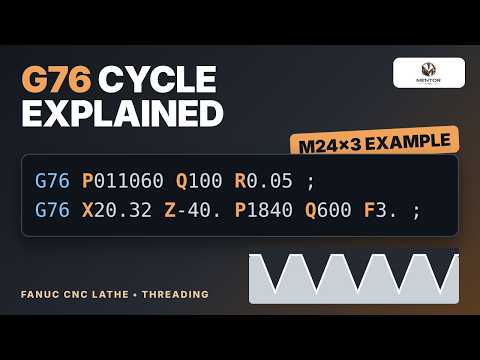
Threading on a CNC lathe can seem daunting, especially when programming complex pitches manually. Fortunately, the FANUC G76 threading cycle simplifies the process by allowing machinists to cut a complete, high-precision thread using just two blocks of G-code. Whether you write code directly at the controller or generate it using modern CNC software, understanding how the G76 cycle operates is essential for efficient turning operations.
What is the FANUC G76 Threading Cycle?
The G76 cycle is a multiple-repetitive threading cycle used on FANUC and compatible CNC lathe controls. Instead of writing dozens of manual positioning blocks, G76 automatically calculates the depth of cut, pass count, and retraction moves for external or internal threads—such as a standard M24×3 metric thread.
Decoding the Two-Block G76 Format
The standard FANUC two-block G76 code structure appears as follows:
G76 P(m)(r)(a) Q(Δdmin) R(d)
G76 X(U) Z(W) P(k) Q(Δd) F(L)
Here is a breakdown of what these vital parameters represent:
- P(m)(r)(a) [Block 1]: Defines the number of finishing passes (m), chamfer amount (r), and tool nose angle (a, such as 60° for metric threads).
- Q [Block 1]: Sets the minimum cutting depth per pass.
- R [Block 1]: Specifies the finishing allowance.
- X & Z [Block 2]: Represents the target coordinates for the thread core diameter (X) and total thread length (Z).
- P [Block 2]: Thread depth (height from crest to root).
- Q [Block 2]: Depth of the very first cut.
- F: Thread lead or pitch (e.g., F3.0 for an M24×3 thread).
Enhancing Accuracy with CNC Software
While calculating values like thread height ($P$) and initial cut depth ($Q$) manually provides foundational knowledge, modern machine shops rely heavily on powerful CNC software to automate these calculations.
By integrating specialized CNC software into your workflow, you can input thread specifications, automatically output error-free G76 code, and run full 3D toolpath simulations. This eliminates human error and prevents costly machine crashes before the cutting tool ever touches the workpiece.
Conclusion
Mastering the G76 cycle gives you total control over your CNC lathe's threading capabilities. Combining a solid grasp of G-code fundamentals with simulation tools ensures your thread-cutting operations remain fast, accurate, and repeatable.


