Demystifying Threading Inserts: IR vs ER for Smart CNC Operations
This article provides an in-depth exploration of Smart CNC, covering foundational concepts, practical applications, and engineering insights.
Precision is the backbone of modern manufacturing. When it comes to thread turning on a lathe, selecting the right insert geometry can make or break your finish quality and overall tool longevity. Among the most popular tooling choices in modern machine shops are IR and ER indexable inserts. Understanding how these tools function within a modern Smart CNC environment helps machinists maximize efficiency while maintaining tight tolerances.
What Are IR and ER Threading Inserts?
In indexable tooling systems, standardized letter codes define the specific application and direction of the cutting edge:
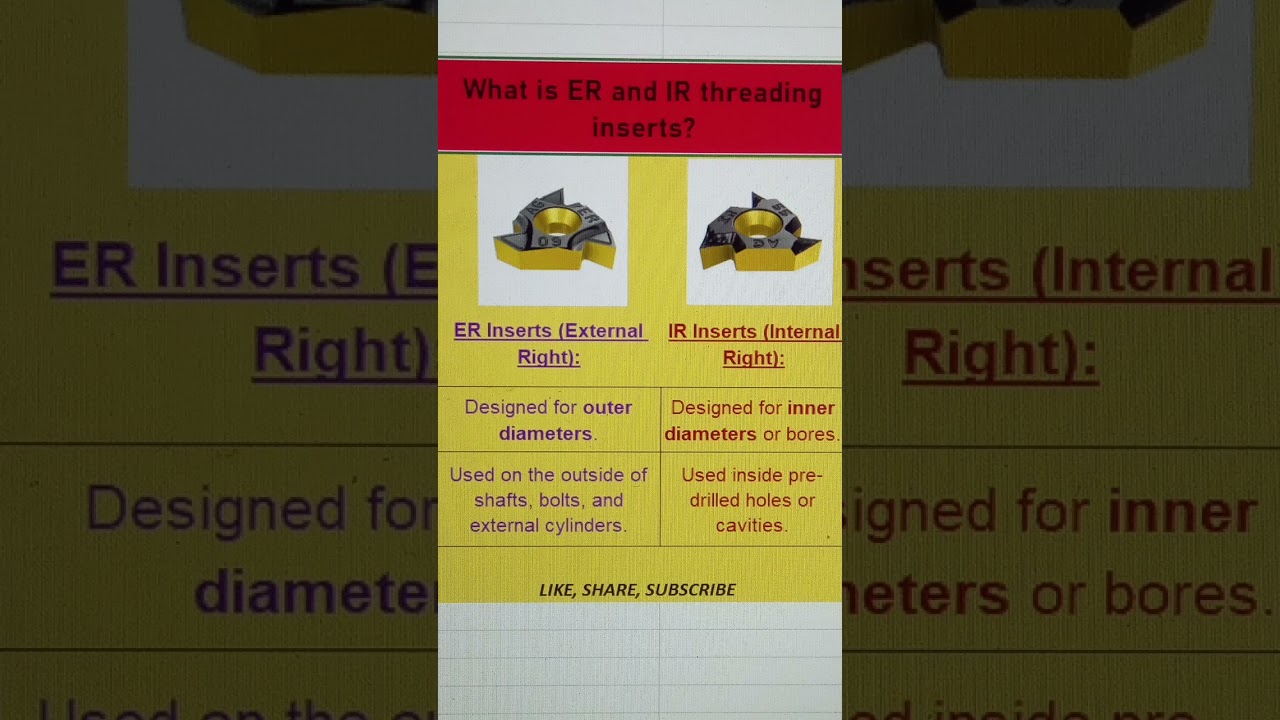
- ER (External Right-Hand): Engineered specifically for external thread cutting applications—such as bolts, studs, or shafts—running in a standard right-hand spindle rotation.
- IR (Internal Right-Hand): Tailored for internal threading tasks—such as nuts, tapped bores, or internal pipe threads—cutting from right to left inside a workpiece bore.
While IR and ER inserts may look similar at first glance, their clearance angles, cutting edge orientations, and chip breaker geometries are distinct. Using an ER insert for internal threading (or vice versa) leads to poor surface finishes, rapid tool wear, or catastrophic tool breakage.
Maximizing Efficiency in Smart CNC Workflows
Integrating the correct threading insert into a Smart CNC setup ensures optimal chip evacuation and prevents chatter during the threading cycle. Internal threading (IR) demands careful clearance consideration to avoid tool rubbing against the bore wall, whereas external threading (ER) requires maximum tool rigidity to handle higher cutting forces.
Using high-grade carbide IR and ER inserts allows machinists to achieve precise thread profiles, minimize cycle times, and reduce manual intervention—core principles of automated, high-precision manufacturing.
Key Tips for Superior Threading Results
- Match Pitch and Profile: Use full-profile inserts for high-volume, standardized threads, or partial-profile inserts when versatility across multiple pitch sizes is required.
- Verify Center Height: Always ensure the insert tip is set precisely at the center line of the spindle to prevent thread taper and premature edge wear.
- Optimize Pass Increments: Utilize modified flank infeed strategies built into modern CNC controls to ensure smooth chip flow and reduced heat generation.
By incorporating Smart CNC practices and selecting the correct ER or IR insert for your specific application, you can significantly extend tool life, achieve mirror-like thread finishes, and boost shop floor productivity.


