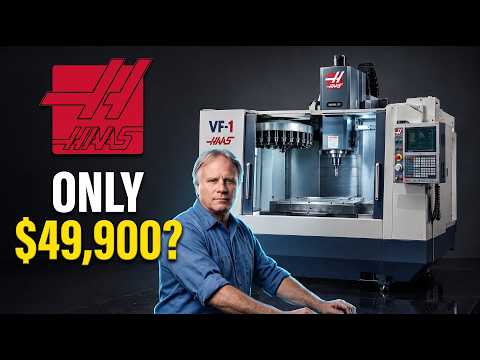
In the late 1980s, the American manufacturing landscape faced a critical turning point. Foreign machine tool builders dominated the market with expensive, complex machinery that small job shops simply couldn't afford. That all changed when a revolutionary CNC invention emerged from a humble California garage, forever altering the trajectory of American metalworking and precision engineering.
Breaking the Foreign Monopoly
In 1988, Gene Haas introduced the Haas VF-1, a vertical machining center priced at an astonishingly low $49,900. At a time when legacy foreign competitors charged nearly double for automated machine tools, Haas's creation seemed almost impossible. Yet, the machine delivered real results, offering high precision, durability, and user-friendly operation tailored specifically for local machine shops.
By drastically lowering the financial barrier to entry, this game-changing CNC invention broke the stranglehold of foreign monopolies. Small business owners no longer had to rely on labor-intensive manual machinery or take on catastrophic debt just to step into the automated digital machining age.
Empowering the Local Job Shop
The arrival of an affordable vertical machining center triggered a massive transformation across the nation. Small American workshops could suddenly compete on precision, speed, and cost against massive industrial conglomerates. Haas accomplished this by prioritizing modular design, straightforward controls, and domestic manufacturing, bringing high-tech automation to everyday machinists.
Beyond its budget-friendly price tag, the machine’s reliability laid the foundation for Haas Automation to become one of the largest machine tool builders in the world. It proved that true disruption in manufacturing doesn't always require overly complex technology—sometimes, it comes from making powerful industrial tools reliable, standardized, and accessible to the masses.
A Lasting Legacy in Modern Manufacturing
Today, the story of Gene Haas's garage-built machine serves as a masterclass in American ingenuity and entrepreneurial spirit. By bridging the gap between affordability and advanced automation, this pioneering CNC invention rescued countless small shops from bankruptcy and revitalized domestic manufacturing from the ground up.


