Precise hole positioning is a fundamental skill for any machinist or programmer working in modern manufacturing. Whether you are creating bolt patterns, flanges, or rotary components, understanding Pitch Circle Diameter (PCD) calculations is crucial for accurate CNC programming.
In this guide, we will break down the essential formulas, hole angles, and X-Y coordinate calculations you need to program bolt hole circles with confidence.
What is Pitch Circle Diameter (PCD)?
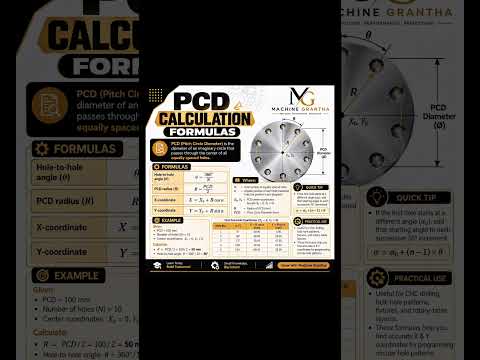
Pitch Circle Diameter (PCD) refers to the diameter of an imaginary circle that passes through the centers of a group of evenly spaced holes. Machining these holes accurately requires converting angular positions on a circle into Cartesian (X and Y) coordinates that the machine tool can read.
Essential PCD Calculation Formulas
To calculate the X and Y coordinates for each hole on a PCD, you need three main pieces of information: 1. PCD (Pitch Circle Diameter) or Radius ($R = \text{PCD} / 2$) 2. Total number of holes ($N$) 3. Start angle ($\theta$)
Step 1: Calculate the Angle Between Holes
To find the angular spacing between adjacent holes, divide 360 degrees by the total number of holes:
Angle per Hole = 360° / Number of Holes
Step 2: Calculate X and Y Coordinates
Using basic trigonometry, calculate the absolute X and Y position for each specific hole angle ($\theta$):
- X Coordinate = Radius × cos(θ)
- Y Coordinate = Radius × sin(θ)
(Note: Ensure your calculator is set to degrees mode when finding sine and cosine values.)
Applying PCD Coordinates to CNC Programming
Once you have calculated the X and Y values for each hole, you can easily plug these points into your G-code routines. In standard CNC programming, canned cycles such as G81 (standard drilling) or G83 (peck drilling) are used alongside these calculated coordinates to execute precise drilling operations around the circle.
For example, on a 4-hole pattern with a 100mm PCD (50mm radius) starting at 0 degrees: - Hole 1 (0°): X = 50.0, Y = 0.0 - Hole 2 (90°): X = 0.0, Y = 50.0 - Hole 3 (180°): X = -50.0, Y = 0.0 - Hole 4 (270°): X = 0.0, Y = -50.0
Final Thoughts
Mastering trigonometric formulas for PCD calculations removes guesswork and ensures exact precision at the machine control screen. By applying these mathematical fundamentals, you can significantly improve your CNC programming workflow and eliminate costly positioning errors on the shop floor.


