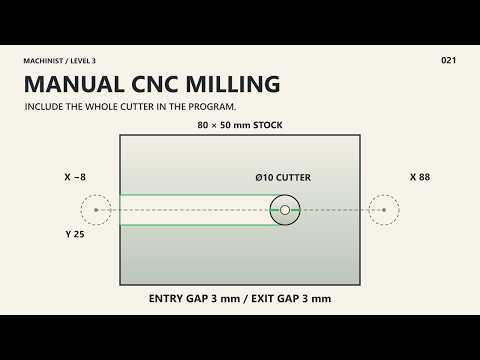
Moving from an engineering drawing to a finished precision component is one of the most fundamental skills for any aspiring machinist. While modern manufacturing relies heavily on automated CAD/CAM software, mastering CNC manual programming gives operators a deeper understanding of machine behavior, toolpaths, and G-code logic.
In this Machinist Level 3 guide, we break down how to take a technical drawing and transform it into a functional G-code program to machine a shallow, open-ended straight slot across a rectangular blank.
Analyzing the Engineering Drawing
Before writing a single line of code, you must carefully study the drawing. Identify key dimensions, tolerances, material specifications, and reference points (the workpiece zero). For this simple exercise, the goal is to cut a straight slot across the width of a rectangular workpiece.
Setting up the coordinate system correctly is critical. By establishing X, Y, and Z zero points precisely, you ensure the cutting tool enters and exits the open ends smoothly without damaging the tool or colliding with workholding fixtures.
Writing the Program Step-by-Step
Once the geometry is clear, you can construct the program manually. A standard CNC manual setup relies on foundational G-codes and M-codes to control spindle speed, feed rates, and tool positioning:
- Tool Setup and Spindle Activation: Call the correct end mill, set the appropriate spindle speed (RPM), and turn on coolant if required.
- Rapid Positioning: Move the tool safely to an entry position off the workpiece using rapid traverse (G00).
- Linear Interpolation: Lower the tool to the target depth and feed linearly across the slot using controlled feed rate (G01).
- Retract and End Program: Lift the tool clear of the stock, stop the spindle, and reset the program safely (M05, M30).
Verifying via Teaching Simulation
Executing a new program directly on a physical machine can carry risks if code errors exist. Utilizing a teaching simulation allows you to visualize the toolpath and verify every line of your CNC manual program. In the virtual environment, you can confirm that the tool moves at the correct feed rate and cuts the shallow slot to the exact specified depth.
Conclusion
Manual programming remains an indispensable core competency in machining. By practicing how to convert a 2D drawing directly into executable code, you sharpen your troubleshooting skills and build the confidence required for complex manufacturing tasks.


