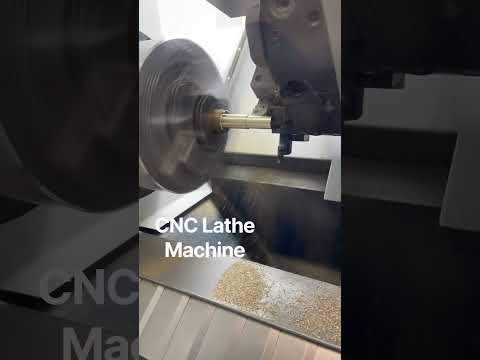
In the world of modern manufacturing, Computer Numerical Control (CNC) technology has revolutionized the way we design and produce intricate components. Among the most vital tools in this field is the CNC Lathe Machine. Whether you are a student of mechanical engineering or a professional in the industry, understanding the mechanics behind these machines is essential for mastering precision production.
What is a CNC Lathe Machine?
A CNC Lathe is a high-precision machine tool that rotates a workpiece on a spindle to perform various operations such as cutting, sanding, knurling, drilling, and turning. Unlike manual lathes, which require a skilled operator to move the cutting tools by hand, CNC lathes are automated and controlled by computer programs. This results in unparalleled accuracy and repeatability.
The CNC Working Principle Explained
To understand how these machines operate, we must look at the core CNC working principle. The process begins with a digital design, typically created using Computer-Aided Design (CAD) software. This design is then converted into a series of numerical instructions, known as G-code and M-code.
The fundamental CNC working principle involves the machine’s control unit reading these codes and sending precise electronic signals to the motors. These motors drive the machine’s axes (typically the X and Z axes for a lathe), moving the cutting tool along the rotating workpiece with extreme precision. Because the movement is controlled by software rather than human hands, the machine can produce complex geometries that would be impossible to achieve manually.
Key Components of a CNC Lathe
A standard CNC Lathe consists of several critical parts that work in harmony: * The Headstock: Contains the main spindle and the motor that powers the rotation. * The Chuck: The clamping device that holds the workpiece securely in place. * The Turret: A rotating tool holder that allows the machine to switch between different cutting tools automatically. * The Bed: The sturdy base that supports all components and ensures stability during high-speed operations.
Common Operations and Benefits
By leveraging the CNC working principle, manufacturers can perform various operations such as "turning" to create cylindrical parts, "facing" to create flat surfaces, and "threading" for screws and bolts. The primary benefits of using CNC lathes include reduced labor costs, increased production speed, and the ability to manufacture parts with tolerances as tight as a few microns.
In conclusion, the CNC Lathe is a powerhouse of the modern factory. By integrating advanced software with robust mechanical hardware, it remains the go-to solution for creating everything from automotive parts to aerospace components.


