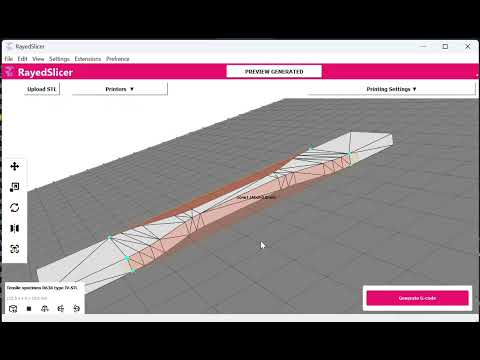
Fused Filament Fabrication (FFF) has transformed rapid prototyping and digital manufacturing, but balancing structural strength with material efficiency remains a common challenge. Enter Adaptive Reinforcement Zoning (ARZ)—a modern slicing methodology designed to strategically reinforce specific areas of a 3D-printed part. By intelligently tailoring your underlying G-code data, you can significantly boost mechanical performance without unnecessarily increasing print time or weight.
Understanding Manual Reinforcement Zone Definition
While fully automated algorithms are powerful, they cannot always anticipate functional stress vectors that a human engineer understands. This is where a "Human-in-the-Loop" approach becomes essential.
Manual Reinforcement Zone Definition allows designers to step into the slicing workflow and explicitly designate high-stress regions within a 3D model. By combining engineering intuition with automated toolpath generation, users can pinpoint exact geometric locations that demand extra reinforcement, such as bolt holes, load-bearing brackets, or flexure points.
The G-code Preparation Workflow
Preparing a model for Adaptive Reinforcement Zoning involves a streamlined pre-processing workflow:
- Model Import & Analysis: The 3D model is loaded into the software interface to evaluate structural demands.
- Zone Identification: The user manually marks targeted regions requiring enhanced mechanical strength.
- Toolpath Customization: The software adjusts local extrusion rates, infill density, or perimeter counts specifically within those defined boundaries.
- G-code Export: The customized parameters are compiled into optimized G-code data ready to be executed by the 3D printer.
This process ensures that localized toolpath adjustments are seamlessly integrated into the global movement commands of the machine.
Key Advantages of the ARZ Workflow
Integrating human expertise into the ARZ toolpath generation process yields major benefits for additive manufacturing:
- Targeted Mechanical Integrity: Reinforce only critical load areas rather than over-engineering the entire part.
- Optimal Resource Efficiency: Save filament and reduce overall print times by maintaining lightweight infill in non-critical zones.
- Enhanced Process Control: Engineers retain full command over how the exported G-code data dictates printer nozzle trajectories and material deposition.
Mastering manual reinforcement zoning enables 3D printing professionals to produce stronger, lighter, and more efficient components tailored precisely to their real-world applications.


