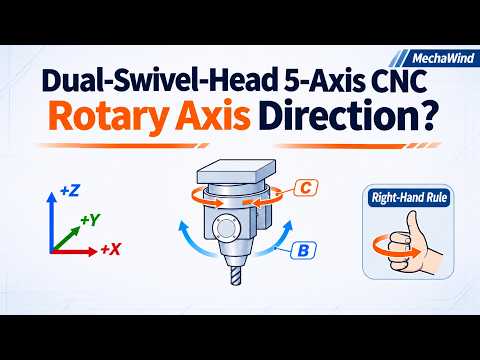
5-axis machining unlocks incredible flexibility for producing complex, high-precision geometries. However, understanding rotational axes can be confusing for operators and programmers working with advanced machine setups. If you operate a dual-swivel head CNC machine, mastering the positive and negative rotation directions of the B and C axes is essential for accurate setup, precise programming, and crash-free operation.
The Right-Hand Rule: The Golden Standard
Before identifying specific movements on a dual-swivel head, you must rely on the fundamental standard of multi-axis machining: the Right-Hand Rule.
In standard Cartesian coordinate systems, linear movement across the X, Y, and Z axes corresponds directly to rotational axes A, B, and C: - A-Axis: Rotates around the X-axis. - B-Axis: Rotates around the Y-axis. - C-Axis: Rotates around the Z-axis.
To determine the positive direction of rotation, point the thumb of your right hand in the positive direction of the corresponding linear axis. The natural curl of your fingers indicates the positive (+) rotational direction.
Identifying B and C Axis Directions on a Dual-Swivel Head
In a dual-swivel head configuration, both rotational axes are located entirely within the spindle head rather than on the worktable. Here is how to verify their directions:
1. The B-Axis (Tilt Around Y)
The B-axis controls the tilting movement around the Y-axis. * Positive (+B) Direction: Point your right thumb along the positive Y-axis (typically pointing to the right side of the machine). The curling direction of your fingers defines positive (+B) rotation.
2. The C-Axis (Rotation Around Z)
The C-axis controls the rotary movement around the Z-axis (parallel to the tool spindle centerline). * Positive (+C) Direction: Point your right thumb upward along the positive Z-axis. The natural curl of your fingers defines positive (+C) rotation, which corresponds to a counter-clockwise movement when looking down from above the spindle head.
Why Correct Axis Identification Matters
Misinterpreting positive and negative rotational vector values can lead to severe programming errors, material gouging, or disastrous tool collisions. When configuring your post-processor or setting up a modern 5-axis CNC machine, verifying rotational directions prevents costly operational downtime.
By consistently applying the Right-Hand Rule to your dual-swivel head configuration, you can ensure your CNC machine runs smoothly, safely, and with maximum precision every time.


