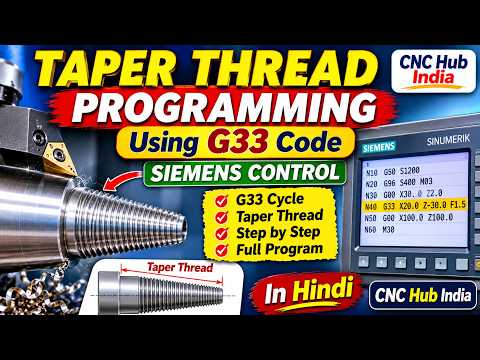
Taper threading is one of the more advanced yet essential skills every machinist must master. Whether you are working on specialized pipe fittings, valves, or industrial connectors, the ability to program a precise taper thread is a hallmark of professional expertise. For those undergoing CNC training, understanding the nuances of the Siemens SINUMERIK control system is a significant step toward becoming a proficient programmer.
Understanding the G33 Command
In the Siemens SINUMERIK environment, the G33 command is utilized for threading with a constant lead. While many modern systems offer simplified canned cycles, G33 remains a powerful tool for custom threading operations. When executing a taper thread, G33 allows the tool to move simultaneously along both the X and Z axes while remaining perfectly synchronized with the spindle rotation.
Unlike a standard straight thread where only the Z-axis typically changes, a taper thread requires a calculated change in diameter over the length of the cut. This requires the programmer to define both the longitudinal (Z) and transverse (X) end points within the same block.
Why Taper Threading Matters
The demand for taper threads is high in industries like oil and gas, hydraulics, and plumbing. Because these threads provide a tighter, leak-proof seal as they are tightened, their accuracy is non-negotiable. Through hands-on CNC training, operators learn that even a small calculation error in the taper angle can lead to scrapped parts or mechanical failure.
Programming Logic on Siemens SINUMERIK
To program a taper thread using G33, you must define: 1. The Start Point: Where the tool begins its path. 2. The End Point (X and Z): The final coordinates that define the taper's slope. 3. The Pitch (K or I): The distance the tool travels per revolution.
For example, a typical block might look like: G33 Z-40 X35 K2.5. In this instance, the machine interprets that it must reach Z-40 and X35 simultaneously while maintaining a pitch of 2.5mm. Mastering these manual entries builds a deeper understanding of machine kinematics, which is a core objective of any high-quality CNC training program.
Conclusion
Programming taper threads using G33 on a Siemens SINUMERIK control might seem daunting at first, but it offers unparalleled control over the machining process. By focusing on the relationship between axis synchronization and pitch, you can produce high-precision components that meet strict industrial standards. Continuous practice and specialized instruction remain the best ways to perfect these technical skills.


